
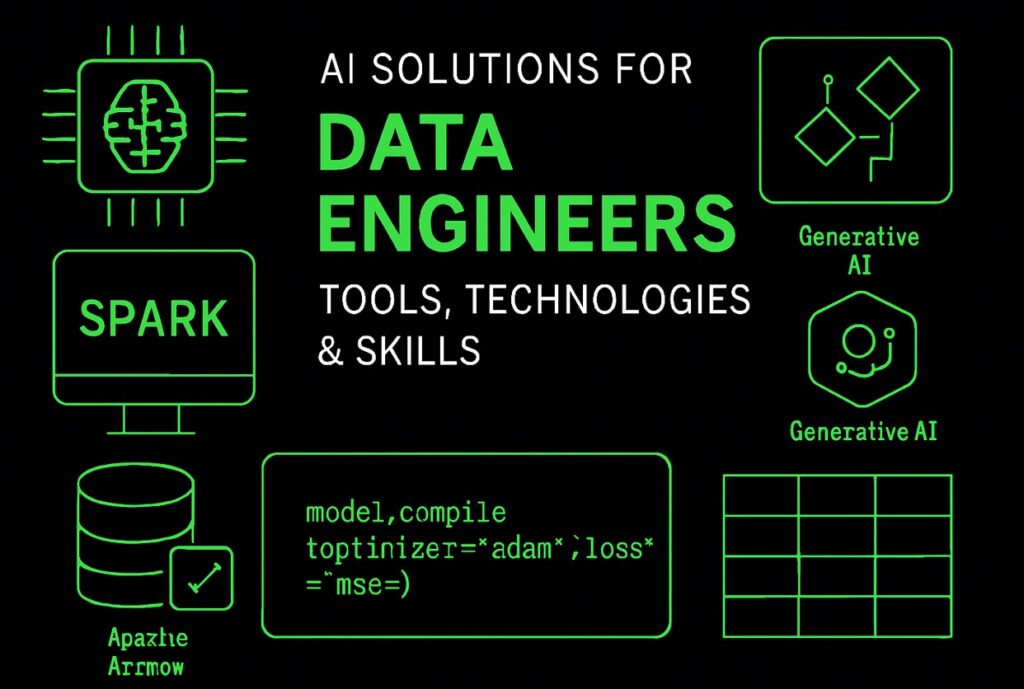
Data Engineers are no longer just pipeline builders—they’re architects of intelligent, scalable, and AI-powered data ecosystems. As businesses demand real-time insights and predictive capabilities, Data Engineers must master a blend of traditional tools and cutting-edge technologies.
🧰 Essential Tools for Modern Data Engineers
1. Apache Spark
A powerful open-source engine for large-scale data processing.
Python
from pyspark.sql import SparkSession

spark = SparkSession.builder.appName("DataEngineerDemo").getOrCreate()
df = spark.read.csv("data.csv", header=True, inferSchema=True)
df.groupBy("category").count().show()
2. Apache Airflow
Used for orchestrating complex workflows.
Python
from airflow import DAG
from airflow.operators.python_operator import PythonOperator
from datetime import datetime

def extract():
    print("Extracting data...")

dag = DAG('data_pipeline', start_date=datetime(2023, 1, 1), schedule_interval='@daily')
task = PythonOperator(task_id='extract_task', python_callable=extract, dag=dag)
3. dbt (Data Build Tool)
Transforms raw data in your warehouse using SQL.
SQL
-- models/customer_orders.sql
SELECT customer_id, COUNT(order_id) AS total_orders
FROM {{ ref('orders') }}
GROUP BY customer_id
4. Snowflake / BigQuery / Redshift
Cloud-native data warehouses for scalable analytics.
🤖 AI Technologies Reshaping Data Engineering
1. Generative AI for ETL Automation
Tools like GPT-4 and Code Interpreter can auto-generate transformation logic, documentation, and even SQL queries.
2. ML Pipelines with TensorFlow & PyTorch
Data Engineers now build and deploy ML models as part of their workflows.
Python
import tensorflow as tf

model = tf.keras.Sequential([
    tf.keras.layers.Dense(64, activation='relu'),
    tf.keras.layers.Dense(1)
])
model.compile(optimizer='adam', loss='mse')
3. AI Observability Tools
Platforms like Monte Carlo and Datafold use AI to detect anomalies, schema changes, and data quality issues.
🌐 Cloud Platforms & Integration Skills
- AWS Glue / Azure Data Factory / GCP Dataflow Managed ETL services for scalable data movement.
- MuleSoft / Kafka / Fivetran Real-time data integration and API connectivity.
- Docker & Kubernetes Containerization and orchestration for scalable deployments.
🧠 Core Skills for our Data Engineers
| Skill Area | Description |
|---|---|
| SQL & Python | Foundation for querying and scripting |
| Data Modeling | Designing scalable schemas and relationships |
| Workflow Orchestration | Automating pipelines and dependencies |
| Cloud Architecture | Deploying and managing data infrastructure |
| AI & ML Awareness | Supporting model training and inference |
| DevOps & CI/CD | Versioning, testing, and deploying code |
📈 Real-World Use Case: AI-Powered Data Pipeline
A retail company used:
- Airflow to schedule daily ETL jobs
- Spark to process clickstream data
- Einstein AI to predict customer churn
- MuleSoft to integrate CRM and inventory systems
Result
- 30% faster data delivery
- 25% improvement in customer retention
- Real-time dashboard updates across departments
🧭 Future of Data Engineering with AI
The future of data engineering is intelligent, automated, and deeply integrated with AI. Whether you’re building pipelines, deploying models, or optimizing infrastructure, mastering these tools and technologies will keep you ahead of the curve.

Amit Arora is a managing partner in cloud practice, helping senior management teams to align their IT service delivery approaches and frameworks. He is also a father, coach, and influential thinker. He has over two decades of expertise using creative and cooperative methods to serve Canadian and international clients on various cloud integrations and cybersecurity. Amit has devoted the last few years to building up cloud portfolios that cover a wide range of technologies. He earned his master’s degree from the University of New Brunswick, Canada and many certificates relevant to his line of employment. LinkedIn Profile